
In industrial vision inspection systems, clear, stable imaging is the cornerstone of precise measurement, positioning, recognition, and defect analysis. As a key optical control component, industrial filters precisely regulate light entering the lens—resolving common imaging challenges and boosting system robustness. Below, we break down their core functions, classifications, and practical applications through typical industrial cases.

I. Core Functions & Classification of Industrial Filters
Industrial filters are primarily categorized by how they regulate light’s physical properties, with two core types:
Industrial Lens Filters: Solving Imaging Pain Points Across Core Vision Inspection Scenarios
In industrial vision inspection systems, clear, stable imaging is the cornerstone of precise measurement, positioning, recognition, and defect analysis. As a key optical control component, industrial filters precisely regulate light entering the lens—resolving common imaging challenges and boosting system robustness. Below, we break down their core functions, classifications, and practical applications through typical industrial cases.
I. Core Functions & Classification of Industrial Filters
Industrial filters are primarily categorized by how they regulate light’s physical properties, with two core types:
1. Spectral-Selective Filters
Principle: By depositing precision optical films on optical substrates, these filters leverage light interference to efficiently transmit specific wavelength bands while reflecting or absorbing others.
Main Types: Bandpass filters, shortpass/longpass filters, neutral density (ND) filters.
2. Polarization-Selective Filters
Principle: Their internal structure only allows light with an electric vector vibration direction aligned with its polarization axis to pass through. This eliminates polarized light (e.g., glare) in unwanted directions.
Main Types: Linear polarizers, circular polarizers.
II. Deep Dive into Industrial Application Scenarios
Filters address targeted imaging pain points across industries—here’s how they work in real-world settings:
Application 1: High-Speed Assembly Line Barcode Reading
Core Challenge: Ambient light (especially flickering fluorescent lamps) causes brightness fluctuations and stripes, reducing barcode reading rates.
Solution: Narrowband bandpass filter
Technical Details:
- Pair an 850nm central wavelength infrared LED (active light source) with a narrowband bandpass filter (850nm central wavelength, 10nm/20nm bandwidth).
- This forms an "optical lock": only LED-emitted infrared light enters the camera, blocking most ambient visible light.
Outcome: Delivers high-contrast, flicker-free images under any lighting conditions, stabilizing reading rates.
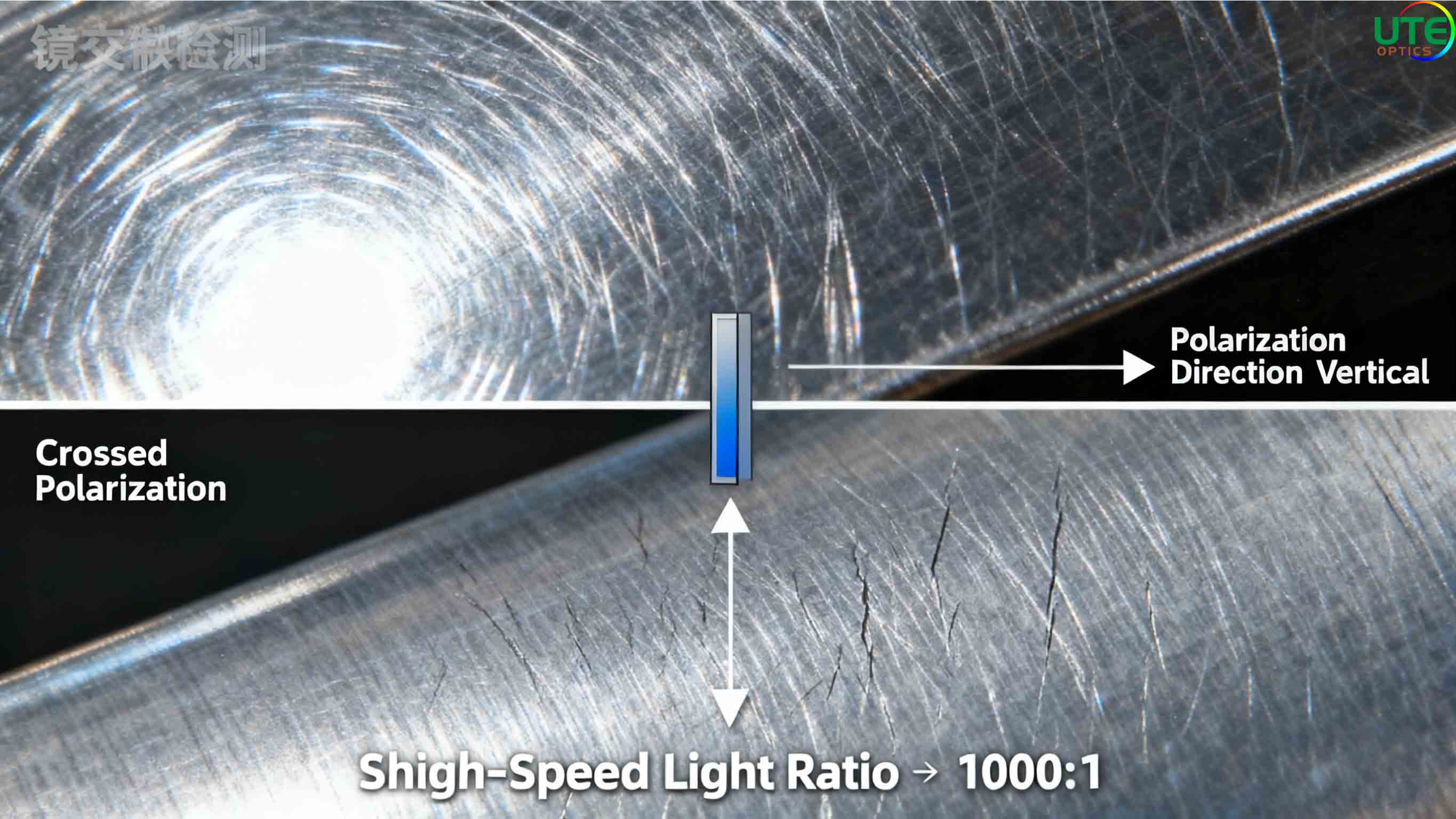
Application 2: Metal Surface Micro-Scratch & Defect Detection
Core Challenge: Strong specular reflection on smooth metal surfaces creates bright spots, masking scratches, pits, and other defects.
Solution: Linear polarizing filter
Technical Details:
- Install linear polarizers in front of both the light source and lens, forming a "crossed polarizer" optical path.
- Rotate the lens-side polarizer so its polarization direction is perpendicular to the source-side polarizer.
- Specular reflection is blocked (due to mismatched polarization), while diffuse reflection from scratches partially passes through.
Key Parameter: Polarizer extinction ratio ≥ 1000:1 to ensure effective light blocking.
Outcome: Defects stand out clearly against a dark background.
Application 3: Transparent Packaging Inspection (Liquid Impurities & Bottle Defects)
Core Challenge: Complex reflection/refraction from glass bottles interferes with observing internal foreign objects, bubbles, or surface scratches.
Solutions:
- Scene A (Surface Scratches/Labels): Polarizing filter eliminates scattered reflections across the bottle surface (same principle as Application 2).
- Scene B (Internal Liquid Impurities): Longpass filter (e.g., 1050nm cut-off wavelength) paired with an infrared light source and IR camera. Many liquids/glasses are transparent in visible light but scatter specific IR wavelengths—impurities appear as bright spots against a dark background.
Application 4: Plastic Material Sorting in Recycling
Core Challenge: Similar-looking plastics (e.g., PET vs. PVC) can’t be distinguished by color or shape alone.
Solution: Infrared bandpass filter
Technical Details:
- Use a near-infrared (NIR) camera with an IR light source.
- Alternate infrared bandpass filters with different central wavelengths (e.g., 1200nm, 1300nm, 1450nm) for imaging.
- Different plastics have unique reflectance in these characteristic bands—construct an accurate classification model by calculating gray value ratios across multi-band images.
Industrial filters turn "unusable" images into reliable data, directly impacting inspection accuracy and production efficiency. Whether resolving ambient light interference, eliminating glare, or distinguishing materials, the right filter tailored to your scenario is critical.

For customized filter solutions matching your industrial vision system needs—from spectral selection to polarization control—contact our technical team for a free consultation today!