

What is a variable neutral density (ND) filter, and how does it relate to a graduated ND filter? In photography, light serves as the fundamental medium for image creation; however, excessive illumination can disrupt exposure balance and compromise detail retention. To manage such challenges, photographers employ various optical filters, among which the variable ND filter and the graduated ND filter are two essential tools. Although both are designed to mitigate light intensity, they differ significantly in function and application. A comprehensive understanding of their respective roles is necessary to determine their relationship.

1. Variable ND Filter
As the name implies, a variable ND filter enables continuous adjustment of light attenuation. Its primary function is to uniformly reduce the amount of light entering the lens across the entire frame.
Working Principle: This filter typically consists of two polarizing elements—one fixed linear polarizer and one rotatable circular polarizer. Rotating the outer ring alters the relative angular alignment between the two polarizers. When the polarization axes are aligned, maximum light transmission occurs; when they are orthogonal, light transmission is minimized. This mechanism, known as polarization extinction, allows for seamless adjustment of light reduction within a specified range.
Primary Applications:
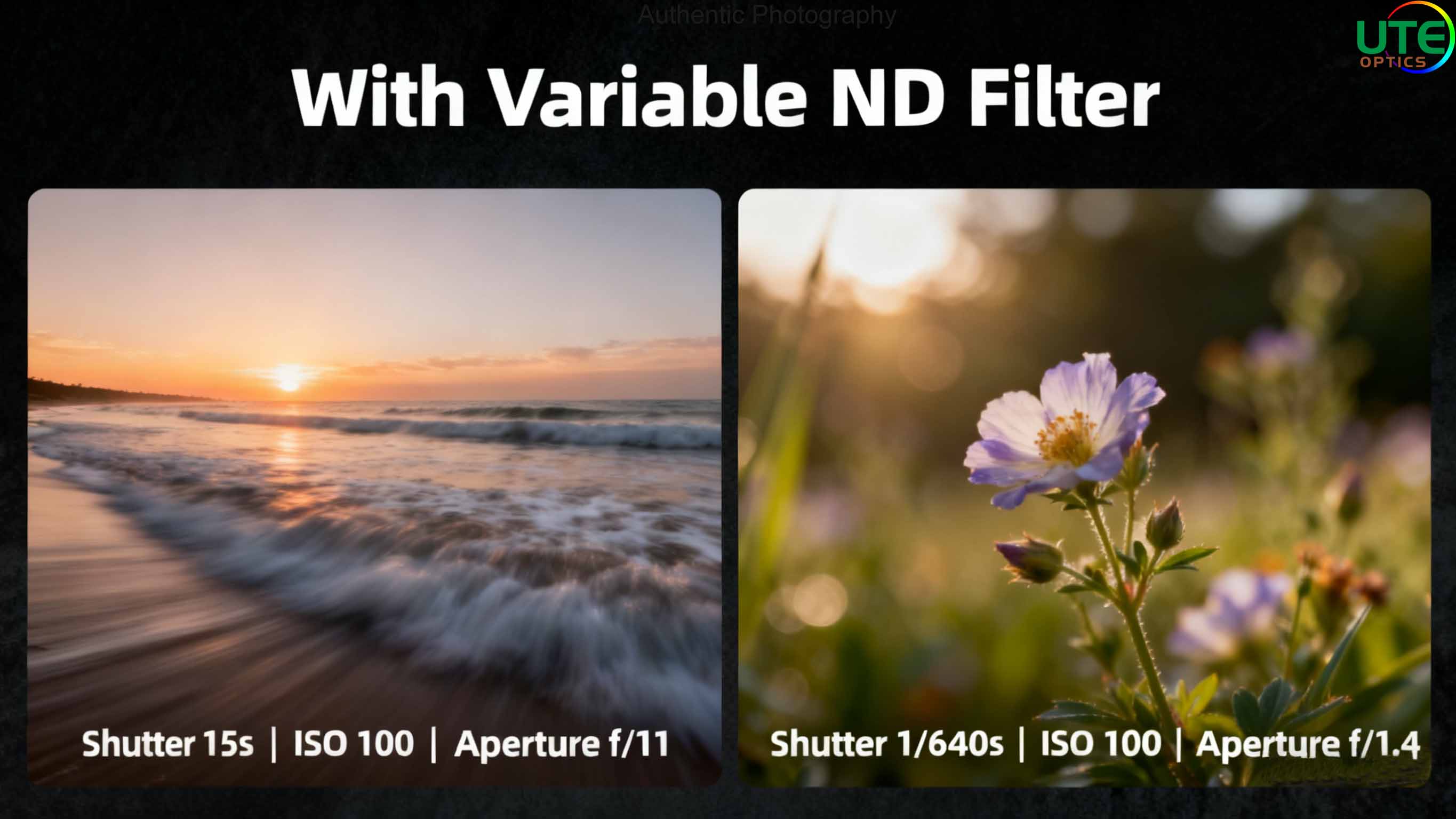
- Long Exposure Photography: In bright conditions, achieving slow shutter speeds—necessary for rendering motion blur in waterfalls, rivers, or clouds—can be challenging due to overexposure. Even at the smallest aperture and lowest ISO, ambient light may exceed acceptable exposure levels. A variable ND filter mitigates this by reducing overall luminance, enabling exposure durations of several seconds or more.
- Wide-Aperture Shooting in Bright Light: When using large apertures (e.g., f/1.4) to achieve shallow depth of field and background blur (bokeh), the resulting shutter speed may surpass the camera’s maximum limit (e.g., 1/4000 s). The use of a variable ND filter reduces incoming light, permitting correct exposure while maintaining desired aperture settings.
Advantages and Limitations:
Advantages: Offers versatility by replacing multiple fixed ND filters, thereby reducing equipment load and increasing operational efficiency.
Limitations: At extreme attenuation settings, artifacts such as cross-shaped vignetting (X-pattern), color casts, or uneven darkening may occur, potentially affecting image quality.
In essence, a variable ND filter functions analogously to adjustable sunglasses for a camera lens, uniformly dimming the entire scene to facilitate creative exposure techniques.
2. Graduated ND Filter
If a variable ND filter acts as full-frame shading, a graduated ND filter operates like a half-lens shade.
Working Principle: This filter features a gradient transition from a darkened upper section to a clear lower section, with a defined transitional zone. It provides fixed levels of attenuation (e.g., ND0.6, ND0.9) and lacks adjustability.
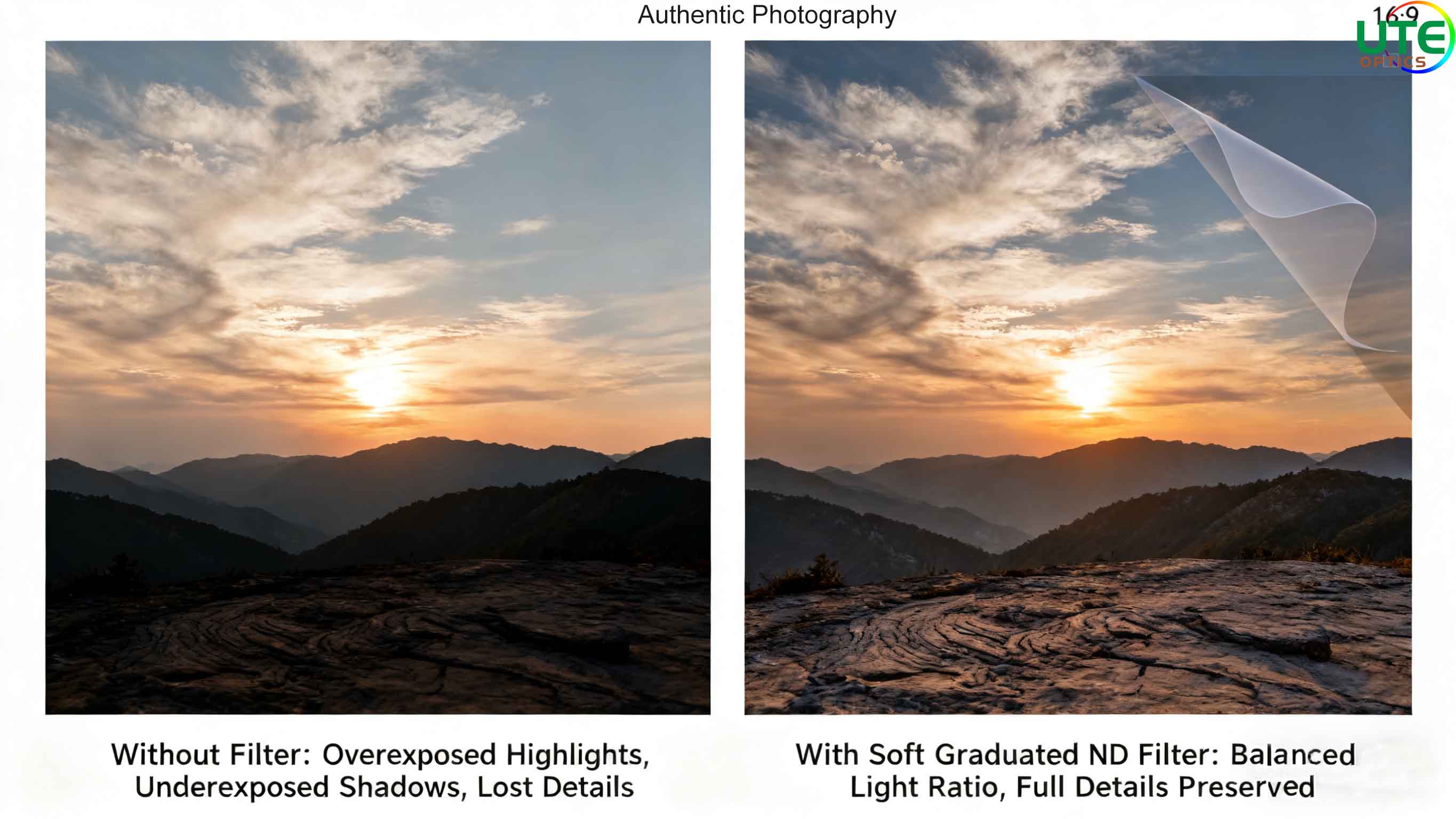
Primary Application: Dynamic Range Management: Its principal role is to balance high-contrast scenes, such as landscapes during sunrise or sunset, where the sky is significantly brighter than the foreground. Without intervention, cameras often fail to capture detail in both regions—resulting in either blown-out highlights or blocked shadows. By positioning the darkened portion over the bright sky and the transparent portion over the darker ground, the filter compresses the scene’s dynamic range, preserving detail in both areas.
Classification by Transition Profile:
- Hard Graduated Filter: Features a sharp transition, ideal for scenes with distinct, level horizons (e.g., seascapes).
- Soft Graduated Filter: Exhibits a gradual transition, suitable for uneven terrain with mountains or trees interrupting the horizon.
- Reverse Graduated Filter: Darker at the center of the gradient and gradually lighter toward the top, specifically designed for sunsets where the brightest area lies just above the horizon.
In summary, the graduated ND filter serves as an exposure equalizer, selectively attenuating specific regions of the frame rather than applying uniform darkness.
3. Relationship Between Variable and Graduated ND Filters
The relationship between these two filters is not one of substitution but of functional complementarity. Both contribute to advanced light management in photography, yet fulfill distinct roles.
Functional Differentiation:
- The variable ND filter provides global light reduction, affecting all areas of the image equally.
- The graduated ND filter delivers localized attenuation, targeting only specific high-luminance zones.
Application Contexts:
- Variable ND filters are primarily used to manipulate temporal aspects of exposure, such as enabling long exposures under bright conditions.
- Graduated ND filters address spatial imbalances in luminance, particularly in high-contrast static compositions.
Synergistic Use:
In complex lighting scenarios, professional photographers often combine both filters. For instance, consider capturing a coastal scene at sunset with a silky water effect:
Step 1 – Balance Scene Luminance: A soft graduated ND filter is applied to darken the bright sky while preserving exposure on the darker foreground.
Step 2 – Enable Long Exposure: Despite balanced exposure, ambient light may still prevent sufficiently slow shutter speeds. A variable ND filter is then added to further reduce overall illumination, allowing shutter speeds of several seconds.
Result: The combined use yields an image with well-exposed land and sky, along with motion-blurred water, demonstrating optimal control over both spatial and temporal exposure parameters.
In conclusion, the variable ND and graduated ND filters are complementary instruments in a photographer’s toolkit. The former acts as a temporal control device, enabling manipulation of exposure duration; the latter functions as a spatial regulator, harmonizing luminance distribution across the frame. Mastery of their individual and combined applications empowers photographers to transcend technical limitations and exercise precise artistic control over light.