
I. What is a Lens? – The "Heart" of Optical Systems
A lens is a core optical component crafted from transparent materials like optical glass or quartz, controlling light propagation through the principle of refraction. Simply put, it acts as a "traffic controller" for light paths, guiding light to either converge or diverge as needed.
Classification: By shape and functional purpose, lenses fall into two primary categories:
- Convex lenses (thicker at the center, thinner at the edges) – designed to converge light.
- Concave lenses (thinner at the center, thicker at the edges) – engineered to diverge light.
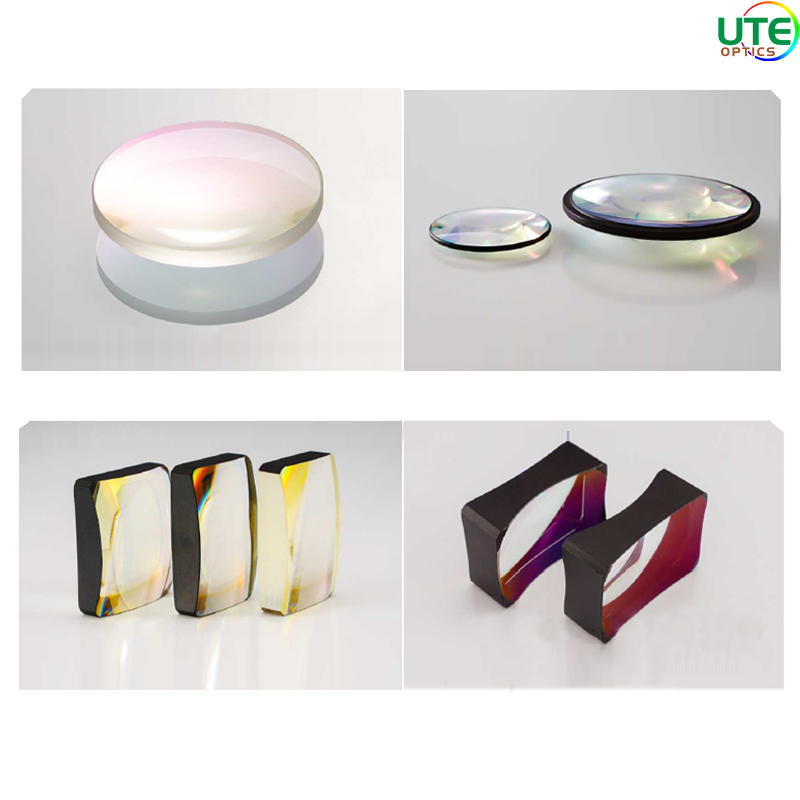
UTE’s lens portfolio covers all key types, including plano-convex, biconvex, plano-concave, biconcave, meniscus, and cemented lenses. Materials range from K9 glass to UV quartz, tailored to meet the demands of diverse wavelength bands.
Core Feature: A lens’s imaging capability forms the backbone of optical devices like cameras and microscopes. For example, a convex lens can focus parallel light rays to a single focal point, while a concave lens spreads light rays outward.
II. What are the Uses of Lenses? – The Universal Enabler Across Industries
Lenses are ubiquitous in high-tech fields, and UTE’s lens products have been successfully integrated into a wide range of industry scenarios:
- Medical Imaging: Miniature lenses in endoscopes enable doctors to clearly visualize internal human structures. Notably, UTE’s ultra-precision lenses helped a leading brand of enzyme immunoassay analyzers boost detection accuracy by 20%.
- Industrial Laser Processing: In CO₂ laser systems, lenses focus energy to achieve precise cutting, welding, and marking – a capability leveraged in UTE lens applications for laser marking machines.
- Consumer Electronics: Smartphone cameras and VR headsets rely on multi-lens assemblies to deliver high-fidelity imaging.
- Research & Aerospace: Large-aperture lenses in astronomical telescopes capture faint starlight, while infrared thermal imagers use germanium lenses for non-contact temperature detection.
III. Why Can Lenses Deliver These Functions? – Design Rooted in Optical Principles
A lens’s core capabilities stem from the law of refraction (Snell’s Law):
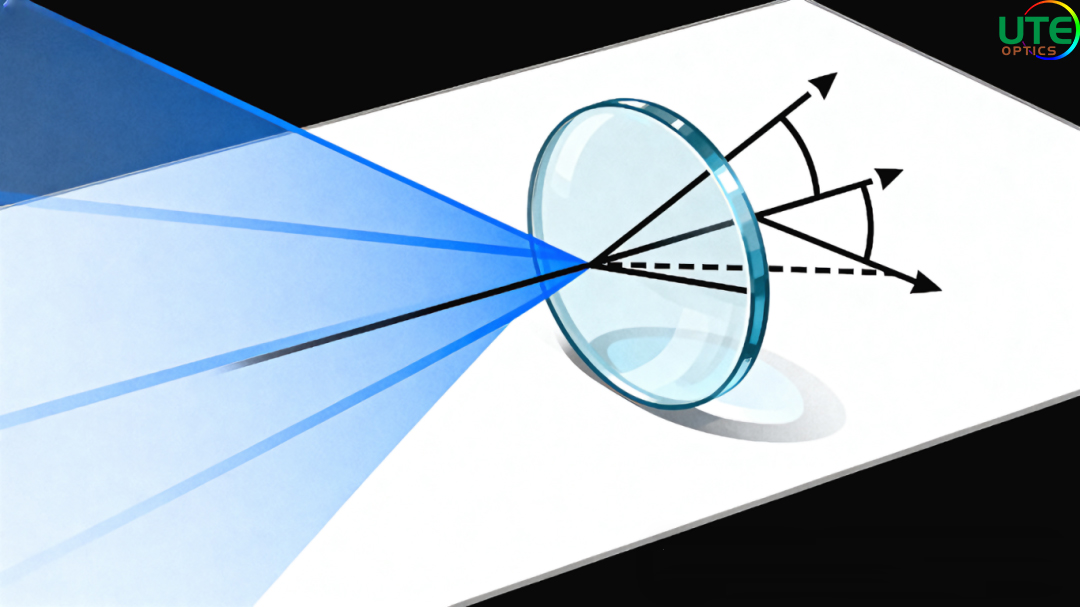
- Convex Lenses: When parallel light passes through a convex surface, it bends toward the optical axis (due to refraction angle changes) and ultimately converges at a focal point. The shorter the focal length (f), the stronger the convergence power.
- Concave Lenses: Light rays bend outward after passing through a concave surface, forming a divergent beam.
To enhance performance, UTE uses precision coating technologies – such as anti-reflection (AR) coatings – to minimize reflection losses. This achieves transmittance of up to 99% in the 400–700nm wavelength band, with customized optimizations available for UV and IR applications.
IV. How to Choose the Right Lens? – Four Key Parameters That Define Performance
Selecting the optimal lens requires focusing on four critical parameters, and UTE offers professional customization services to match specific needs:
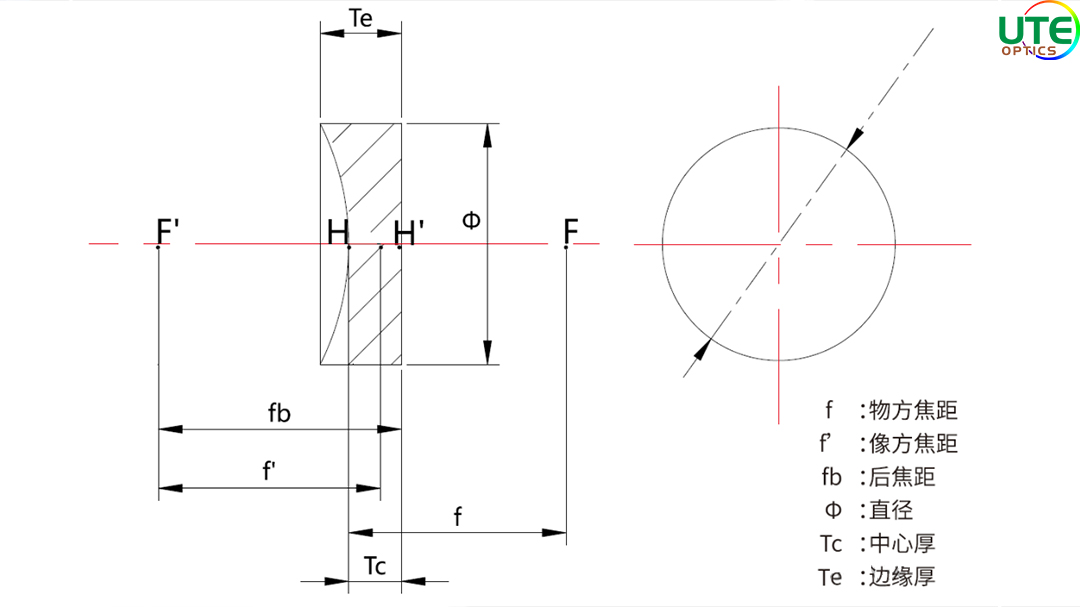
1. Focal Length (f): Determines imaging distance and magnification. For example, projectors need longer focal lengths to enlarge images, while endoscopes require short focal lengths to fit narrow spaces.
2. Aperture & Clear Aperture**: A larger aperture increases light transmission, resulting in brighter images. UTE lenses boast a clear aperture utilization rate of over 90%.
3. Surface Accuracy: Surface flatness directly impacts image clarity. UTE’s products achieve surface accuracy of λ/10 (wavelength-level precision).
4. Material & Coating:
- K9 glass: Ideal for visible light bands, offering a balanced cost-performance ratio.
- UV quartz: Resistant to high temperatures and low in thermal expansion, making it suitable for laser processing equipment.
- Custom coatings: UTE develops tailored narrowband filter coatings for medical devices, for instance, to enhance signal-to-noise ratios.
V. Practical Application Results – A UTE Case Study
A leading smart security firm sought to improve the night vision clarity of its surveillance cameras. UTE delivered a customized plano-convex lens assembly solution:
- Requirement: Reduce optical aberrations and enhance image contrast in low-light conditions.
- Solution: Plano-convex lenses made from K9 glass (8mm focal length) with AR coatings (reflectance < 0.2% in the 400–700nm band).
- Result: Image sharpness improved by 30%, and the client’s product yield rose by 15%.
Though small in size, lenses are the core of optical systems. With nearly two decades of experience in optical component R&D, UTE Optoelectronics has provided customized solutions to over 10,000 customers worldwide. Feel free to leave a message with questions or book a free technical consultation!